Get up to 2% off on your Rupay Credit Card with Foxhog.
More Detailscustomercare.ind@foxhogmail.com
customercare.ind@foxhogmail.com
Get up to 2% off on your Rupay Credit Card with Foxhog.
More DetailsOur Corporate Credit Line and Pay later Services is only Available in India, USA & Germany.
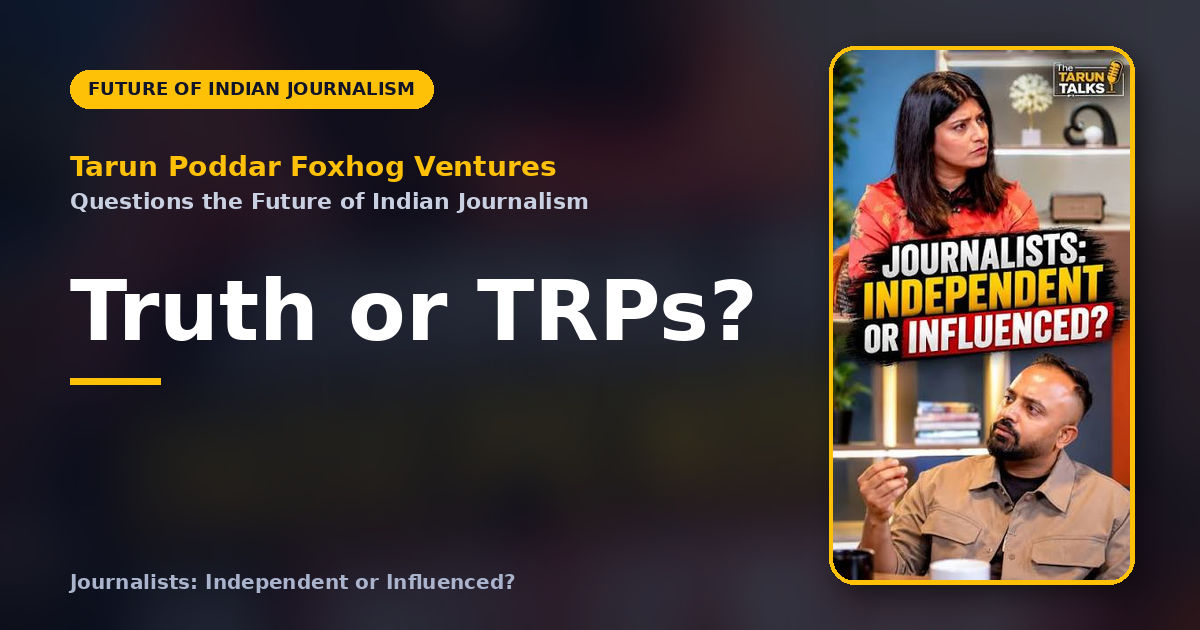
News is opinion, told in words and images. It’s how the people know what is happening in the world around them. But how do we know which opinions to believe? And what if commercial interests clash with the duties of reporting the facts?
These questions are at the heart of the debut episode of The Tarun Talks, a series in which journalist Shweta Kothari discusses the evolution of Indian journalism.
The episode raises questions around credibility of the media, public interest, and accountability, and how business and political interests influence news. The discussion aimed to help the viewers understand headlines better, and to reflect on the role of the press in a democracy.
The first episode of The Tarun Talks is about a topic that all of us in India have experienced: the dynamics between the media and the audiences that consume the media.
Journalism brings the truth to the public, helps hold the powerful to account and informs citizens. It enables the public to make better decisions about their lives and the places they love to live.
But the way in which a story is delivered to the public has altered, pushed by TV ratings, online audiences, commercial considerations, and the need for continuous updates.
Shweta Kothari’s interview raises these issues, and tries to make us ask ourselves whether the media is doing its duty by the people.
A key question raised in this episode is whether news organisations are sufficiently mindful of public interest when commercial interests are increasingly overriding their business.
Media organisations require income to cover the costs of journalists, the work of newsrooms, and to produce reports. Commercial outlets such as advertising may fund some of this work. But such commercial income must not compromise the organisation’s editorial independence.
As audiences grow and advertising revenues increase, some news organisations will be under pressure to cover stories that are more eye-catching. How do you make sure that popular stories are balanced with stories that serve the interests of the public?
The debate in The Tarun Talks makes us reflect on this yet again, and the kind of responsibility that lies on an individual who has to convey news to a much larger audience.
Trust is a vital part of journalism. Audiences rely on news reports to make sense of what is happening, to make decisions about the public, and to help them decide what to believe.
Media credibility can also be compromised with things such as false facts, headlines that are deceptive, poor source verification and lack of transparency. If consumers are unable to differentiate between facts and opinion and speculation, there can be a breakdown of public confidence.
Good journalism involves fact-checking, research, respectful coverage, and the courage to correct errors. News outlets also need to clearly distinguish between reporting, opinions, and advertorials.
Through the title frame, Poddar and Kothari prompt the audience to consider what makes press trustworthy, and why accountability is important.
The press is a commercial enterprise. As other enterprises do, news organisations must have a business model and a good account of the audiences they serve. In parallel, journalism has a public role that extends beyond its commercial duties.
This raises a vital issue: how can media organisations stay financially sustainable without the quality of their reporting suffering and the reports no longer being independent?
Transparency is one part of the solution. Audiences should be able to recognize paid placement, should know when they are looking at an ad versus an article and know when someone is asserting an opinion instead of stating a fact.
Rules of the game. Editorial standards make a difference. Clear guidelines, rigorous checks and professional journalistic practices can help newsrooms safeguard their credibility and achieve business objectives.
The episode touches on these wider issues and invites a conversation about the duties which accompany having a platform.
Good headlines give you a clue about a story but they don’t usually tell the whole story. To get a good understanding you need to dig deeper – read the report, look at a number of other reputable sources and find out the evidence for a claim.
Readers can take a few practical steps to become more informed news consumers:
These habits help people assess information more carefully and take a more active role in public discussions.
In the initial episode, The Tarun Talks is established as a forum for exploring questions that matter to us. Bringing journalist, Shweta Kothari, into the mix, Tarun Poddar moderates a discussion on media, accountability, and the tenuous link between public confidence and commercial success.
The podcast has also provided Foxhog Ventures the chance to record more informal, non-business-related discussions. Entrepreneurship and growing a business does not happen in isolation. But the importance of access to trustworthy knowledge, public awareness and intelligent debate has a huge impact on the terrain where businesses and communities compete.
It’s the type of episode that prompts viewers to make these connections without offering simple solutions to complex issues.
Is the media serving the public, the government, or commercial interests? Is journalism becoming more focused on business goals? And what can news organisations do to maintain public trust?
The first episode of The Tarun Talks raises these questions and invites viewers to consider the role of journalism in India today.
Watch the full conversation with Shweta Kothari below and form your own view.
Watch on YouTube: https://youtu.be/cNw0Eyo2pIo
Media credibility is a concern that warrants some serious debate. The role journalism can play in educating the people, challenging actions and exposing issues. To maintain that role would require careful responsibility, openness and accountability.
Tarun Poddar and Foxhog Ventures uses The Tarun Talks to direct the attention of audiences towards these questions and to look beyond the headlines, explore their various viewpoints and think for themselves.
The conversation is a reminder that the health of a well-informed public is always intimately linked to both what is being reported, as well as how it’s being delivered – thoughtfully, carefully and responsibly.


Leave A Comment